Australia Lesson Activities - Mathstag:www.expedition360.com,2007:/australia_lessons_maths//182007-04-27T08:04:32ZMaths lessons sent from the Outback by the Overland Australia team of Expedition 360 for use by classrooms worldwide free of charge.Movable Type 3.35Road Trains - Ratios / Comparisontag:www.expedition360.com,2001:/australia_lessons_maths//18.9102001-10-14T08:01:38Z2007-04-27T08:04:32ZTHEME: Road Trains SUBJECT AREA: Mathematics TOPIC: Ratios / Comparison 2001 October 14, Sunday. Dorisvale Station, thirty-five kilometres from Pine Creek Looking at the sheer weight of metal involved, and the speed at which road trains travel, it’s more surprising...jasonwww.expedition360.com
Road trains are found on roads throughout the Territory, and are one of the major hazards to other road users, along with cattle and kangaroos. They take a deceptively long time to overtake, and, one single lane roads, you need to completely clear the road to let them pass. Usually you’ll need to stop anyway, to wait for the dust cloud to clear.
Suggested learning activities: Look at the information below, which compares our support vehicle to the unfortunate road train, which blocked its path yesterday. Find the ratio for each comparison. By looking at the average ratio, find out, overall, how much ‘bigger’ the train is. Then compare the train to your family car.
Number of Wheels:
Train: 14 per trailer, 10 on engine
Canter: 6 total
Weight:
Train: 83 tonnes, plus 80x650kg beasts
Canter: 5 tonnes
Length:
Train: 40 metres
Canter: 7 metres
Cattle carrying Capacity:
Train: 80 head
Canter: 7 head
bel
]]>
Money management - cattle mustering coststag:www.expedition360.com,2001:/australia_lessons_maths//18.9032001-10-10T07:26:09Z2007-04-27T07:31:08ZTHEME: ‘Cattle Ranching’ SUBJECT AREA: Maths TOPIC: Money management - cattle mustering costs Your job is to hire a crew to muster a large paddock (gather cattle from a large pasture). Not only is efficiency important, but you must complete...jasonwww.expedition360.com
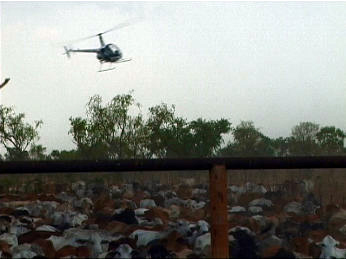
To hire one helicopter to muster the paddock would cost a station $240/hour. This includes the use and maintenance of the helicopter and pilot’s fee of $60/hour. Helicopter fuel is another expense at $60/hour. Total: $300/hour. For a ten-hour day of work, one helicopter would cost $3000. Due to the quickness of travel and the ease with which a helicopter can move about the paddock, mustering time is considerably reduced as horses would have to negotiate the rough terrain, which would take longer to muster.
As a cattle station manager, which do you think would be the most efficient way to complete the mustering?
Suggested activities: Compare the costs of the mustering techniques, predicting the length of time each would take to muster the paddock. Analyse your costs for each and select the most efficient way to complete this job. (Hint: two helicopters mustered this pasture in five hours.) What would be the total costs involved and which is the most economical way to complete this job?
April
]]>
Maths Word Problemtag:www.expedition360.com,2001:/australia_lessons_maths//18.8922001-10-04T06:33:52Z2007-04-27T06:34:49ZInterpreting Math Word Problems: The Information: Well, here we are at the Humbert River in the Gregory National Park. It is our second-to-last layover and we have two weeks left on the trip. Also, we will have a day of...jasonwww.expedition360.com
Interpreting Math Word Problems:
The Information:
Well, here we are at the Humbert River in the Gregory National Park. It is our second-to-last layover and we have two weeks left on the trip. Also, we will have a day of sponsorship filming as well. This leaves us with 11 riding days. The ride up to Darwin will be 590 kilometres from where we are now. It is necessary that we get to Darwin on time because if not, some members of the group will miss their flights, and lose a lot of money.
The Question:
How many kilometres do we need to average each day?
The Method:
We need to analyse the paragraph of info and find which bits are useful to us.
- There are 2 weeks left.
- There are 3 non-riding days.
- That leaves 11 riding days.
- We have 590 kilometres to travel.
Now that we have the information boiled down into little tid-bits, it is easy to look at the problem and figure out a solution.
590 kilometres divided by 11 days will give us the answer.
590/11=53.63
We must travel on average 53.63 kilometres a day!
Suggested activities
1. Use the method of boiling down information to show yourself what figures you need to work with in a math word problem.
2. Also, think up a word problem like this - about how much food you eat a year, how many miles you travel in car on the way to school, the distance each day on a trip you take, etc.
By,
Crister
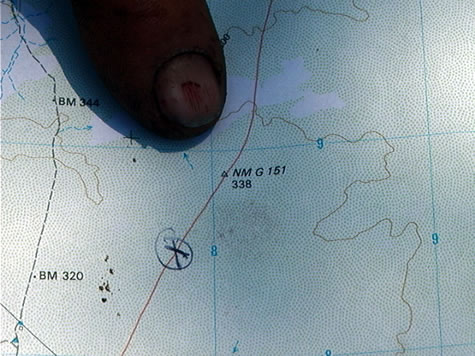
Trig Points and Geometrytag:www.expedition360.com,2001:/australia_lessons_maths//18.8842001-09-30T11:58:35Z2007-04-26T12:02:24ZTHEME: Road to Lajamanu SUBJECT: Maths This unusual marker we came across 40 kms outside Lajamanu is known as a trig, or Trigonometry Point. They are built on the most prominent geological formation in the surrounding countryside so they can...jasonwww.expedition360.com
Note the two bisecting square sheets of iron on the top of the pole. This ensures that the full size will be seen from any angle. Lasers are also used with these trig points to accurately determine the distance the trig point is from your position.
For example:
The surveyor can see trig point A and Trig Point B from the homestead. From the map the surveyor knows that the distance between Trig A and Trig B is 12 kilometres. The angle between the compass bearings of A and B is 105 degrees. What is the distance from the homestead to Trig Point A?
Suggested actives:
Can you find any geological landmarks in your area? If so, does a map say the distance between them? Can you use trigonometry to find the distance from your house to one point?
By, Bushman John and his apprentice Crister
]]>
Hypotenuse & Butch the Lost Dogtag:www.expedition360.com,2001:/australia_lessons_maths//18.8732001-09-25T08:43:19Z2007-04-26T08:51:00ZDownload today's lesson activity (PDF)...jasonwww.expedition360.com
Download today's lesson activity (PDF)
]]>
Counting Rabbitstag:www.expedition360.com,2001:/australia_lessons_maths//18.8682001-09-24T08:20:32Z2007-04-26T08:22:04ZHave you ever thought how something as benign as a rabbit could become such an ecological nightmare? Let’s take a look at how their patterns of development became such an environmental problem in the Australian Outback. Rabbits live in underground...jasonwww.expedition360.com
Have you ever thought how something as benign as a rabbit could become such an ecological nightmare? Let’s take a look at how their patterns of development became such an environmental problem in the Australian Outback.
Rabbits live in underground burrows among dense vegetation, which also provides their food source. They are well protected from predators in these burrows as they can quickly hide.
A female rabbit may have up to five litters of five to seven offspring per year. Although the life span of a rabbit in the wild is not lengthy (maybe two to five years), she is able to reproduce by six months of age. (And, remember, this is only ONE rabbit!)
In a good year, with limited predators (dingoes, foxes, cats), rabbits may reproduce by the thousands. In the Tanami Desert region, with limited vegetation in a normal year, native species of herbivores, like the Bilby, will starve.
Suggested activities: How many offspring can one female rabbit have in her lifetime? Compute the number of rabbits born per year per female rabbit. Imagine the total number of offspring produced per year by a rabbit population if there are 100 rabbits living within a one square kilometre area. If the square kilometre can support only 100 rabbits, what will be the effect of a growing rabbit population on the surrounding area?
April
Firey Equations - Part 2tag:www.expedition360.com,2001:/australia_lessons_maths//18.8592001-09-17T15:46:25Z2007-04-25T14:47:26ZThe bushfires here can be pretty frightening. As I write this, I can see one glowing in the night sky behind me, not too far from camp. In order to get my mind off it, I’ve come up with this...jasonwww.expedition360.com
The bushfires here can be pretty frightening. As I write this, I can see one glowing in the night sky behind me, not too far from camp. In order to get my mind off it, I’ve come up with this little math problem for you to puzzle over:
Bushfires often start in one location and spread outward in a widening circle. The flames can spread with the wind at a speed of up to 50 kilometers per hour!
a) If the distance from the center of the fire to it edge is 200 meters, what circular area has the fire covered?
b) If the fire spreads out from the center as fast as possible (50 kph), how long will it take for the fire to cover a circular area of 100 kilometers?
Firey Equationstag:www.expedition360.com,2001:/australia_lessons_maths//18.8582001-09-17T14:42:04Z2007-04-25T14:45:26Z2001 September 17. Monday. North of Ace Bore. The heart of the fire we saw today was basically a bare piece of black and red ground. The action was at the edges of a circle surrounding this. The burning area...jasonwww.expedition360.com
Although a light but steady wind was present, it did little to blow the fire in any particular direction, so that the only things keeping it from burning outward in a geometric circle were fire-breaks such as the track we followed, and variation in the make up of the groundcover - especially underneath desert oaks, the tallest trees to be found in this area. At some points, the fire did manage to cross the track, as it is rarely used and very overgrown. Here we saw an hourglass shape as the burning ‘funneled’ through the gap.
If a fire began in an evenly vegetated area, where there was no road to distort it, and burned out a circle, we could calculate the area which would be burnt after a given amount of time, by observing how fast the fire travels, and using the formula for the area of a circle: πR2, where R is the radius, or half of the distance across the circle.
If a fire circle with a diameter of eighteen metres travelled at six metres per minute in every direction, work out the following:
* The area of the initial burnt section
* How large the circumference – distance around the fire - would be.
* The diameter of the fire circle after five minutes burning.
* The area of the circle after five, fifteen, and thirty minutes burning.
* How long would it take for the fire to cover one square kilometre.
]]>
Water Consumption Puzzlerstag:www.expedition360.com,2001:/australia_lessons_maths//18.8512001-09-13T14:12:31Z2007-04-25T14:15:28ZMissions and Math How much water do you use in a day? Think about your showers, drinking, food preparation, and even what your dog drinks! Can you imagine getting all the water you would need for six months?! That’s a...jasonwww.expedition360.com
Missions and Math
How much water do you use in a day? Think about your showers, drinking, food preparation, and even what your dog drinks! Can you imagine getting all the water you would need for six months?! That’s a lot of water!
The missionaries out here in the centre of Australia would have to get all the water they would need from the rain! They used rain catchments to get the water and a whole bunch of big tanks to hold it!
We can use so simple multiplication to find out how much water they would need to collect. First we need some givens, or facts that we can work off of.
Givens:
The average person needs about 4 litres of water a day to wash, drink and cook with.
The mission, while still using the rain catchments, had about 20 people in all using the supply.
The dry season would last about 6 months a year on average (Sometimes it would be more, and sometimes less, but we will go with 6 months as an average).
The Math:
The amount of water a person uses in 6 months can be found by multiplying first by 7 (the number of days in week), then by 4 (4 weeks in a month), then by 6 (6 months in the dry season).
4 x 7 x 4 x 6 = 672
A person would use 672 litres in 6 months! That’s crazy!
How many litres would 20 people use in 6 months?
672 x 20 = 13, 440
20 people would use 13, 440 litres in 6 months! Wow!
With this number in their mind, the missionaries could find out what quantity of water their water tanks would hold.
As the mission got bigger and swelled with an overwhelming amount of people, they had to put in a pipeline from a spring about 8 kilometres away!
Suggested activities:
If you and a about 15 other mates, or friends were going to go and set up a community in the middle of nowhere, could you find out how much water you would need to have available?
Think about how long at a time that it wouldn’t rain for.
How much water would you use in a day?
Also, would you ever wash up?…
By,
Crister
Datasheet updatetag:www.expedition360.com,2001:/australia_lessons_maths//18.8452001-09-04T13:37:33Z2007-04-25T13:38:59ZCheck out the latest statistics from the Datasheet...jasonwww.expedition360.com
Datasheet]]>
Time Zonestag:www.expedition360.com,2001:/australia_lessons_maths//18.8282001-08-29T11:39:13Z2007-04-25T11:45:12Z"Allright, you men, gather up on the road for the day's instructions." The sun was breaking over the horizon and Josh, as the day's team leader, was gatherng us prior to our departure. for the day's ride. "First order of...jasonwww.expedition360.com
Crister spoke up, "Why didn't we do this last night, Josh, when we had
more time?" Josh smiled, "Because I would've had to get up a half hour
EARLIER!"
The Northern Territory is on Central Standard Time, which is plus 9 1⁄2
hours from GMT. This is half an hour behind the eastern states,1 1⁄2
hours ahead of Western Australia, and the same as South Australia. Confused?
Don't forget to throw in Daylight Savings Time! It doesn't apply to the
Northern Territory, so from November to March, the eastern states are 1
1⁄2 hours ahead of Northern Territory time, and South Australia is one
hour ahead.
Suggested activities: Examine a time zone map of your country.
- Determine how many time zones are established What determines the size or area of each time zone? Does Daylight Savings Time occur in each area and, if not, what affect does this have as you travel between time zones?
- Select another country around the world and compute the time difference
between the two countries, i.e., if you live in Alice Springs, NT, what time/day is it in Chicago, Illinois, US? (Don't forget to figure in the International Date Line!)
April
Check out the latest statistics on the Datasheet
]]>
Datasheet updatetag:www.expedition360.com,2001:/australia_lessons_maths//18.8242001-08-28T11:27:24Z2007-04-25T11:28:33ZCheck out the latest statistics from the Datasheet...jasonwww.expedition360.com
Datasheet
]]>
Animal Moisture Loss Calculationstag:www.expedition360.com,2001:/australia_lessons_maths//18.8162001-08-26T10:41:43Z2007-04-25T10:45:03ZSunday, 2001, August 26. On the Plenty 'Highway', fifty kilometres east of Jervois Station. Despite what might seem to be an advantage in a largely barren ecosystem, a small creature's survival in the desert can be more difficult than that...jasonwww.expedition360.com
Imagine an 80 kilogram person shrinking to the size of a termite - 8
milligrams. That person would have 200 times more surface area compared
to their volume. Having that much less protected flesh would mean that
they would be losing 200 times as much moisture in the same level of
humidity.
Suggested learning activities: using these figures, work out how much
water loss your own pet, or the average pet dog (10kg) or cat (3kg) or
bird (100g), might have compared to a human. Find the average weights
of different animals; and try this with them. How much less water per
kilogram might an elephant need, under the same conditions?
bel
]]>
Datasheet updatetag:www.expedition360.com,2001:/australia_lessons_maths//18.8092001-08-23T10:07:42Z2007-04-25T10:08:50ZCheck out the latest statistics from the Datasheet...jasonwww.expedition360.com
Datasheet
]]>
AVERAGES + PERCENTAGES - The Great Artesian Basintag:www.expedition360.com,2001:/australia_lessons_maths//18.8072001-08-22T09:55:29Z2007-04-25T09:59:05ZAVERAGES + PERCENTAGES Here are some statistics from the general update: The Great Artesian Basin lies beneath 200 000 people and one fifth of the country. There are about 4700 bores throughout the basin, 850 of which are uncontrolled. 34...jasonwww.expedition360.com
Datasheet and Series
]]>
 As a cattle station manager, which do you think would be the most efficient way to complete the mustering?
Suggested activities: Compare the costs of the mustering techniques, predicting the length of time each would take to muster the paddock. Analyse your costs for each and select the most efficient way to complete this job. (Hint: two helicopters mustered this pasture in five hours.) What would be the total costs involved and which is the most economical way to complete this job?
April
]]>
As a cattle station manager, which do you think would be the most efficient way to complete the mustering?
Suggested activities: Compare the costs of the mustering techniques, predicting the length of time each would take to muster the paddock. Analyse your costs for each and select the most efficient way to complete this job. (Hint: two helicopters mustered this pasture in five hours.) What would be the total costs involved and which is the most economical way to complete this job?
April
]]>
 For example:
The surveyor can see trig point A and Trig Point B from the homestead. From the map the surveyor knows that the distance between Trig A and Trig B is 12 kilometres. The angle between the compass bearings of A and B is 105 degrees. What is the distance from the homestead to Trig Point A?
Suggested actives:
Can you find any geological landmarks in your area? If so, does a map say the distance between them? Can you use trigonometry to find the distance from your house to one point?
By, Bushman John and his apprentice Crister
]]>
For example:
The surveyor can see trig point A and Trig Point B from the homestead. From the map the surveyor knows that the distance between Trig A and Trig B is 12 kilometres. The angle between the compass bearings of A and B is 105 degrees. What is the distance from the homestead to Trig Point A?
Suggested actives:
Can you find any geological landmarks in your area? If so, does a map say the distance between them? Can you use trigonometry to find the distance from your house to one point?
By, Bushman John and his apprentice Crister
]]>